Tutorials
This is a list of topics of interest to those studying crystallography, and in particular to those interested in experimental and computational studies of crystal structures.
If you have any questions, or a topic you would like addressed, please send us an email.
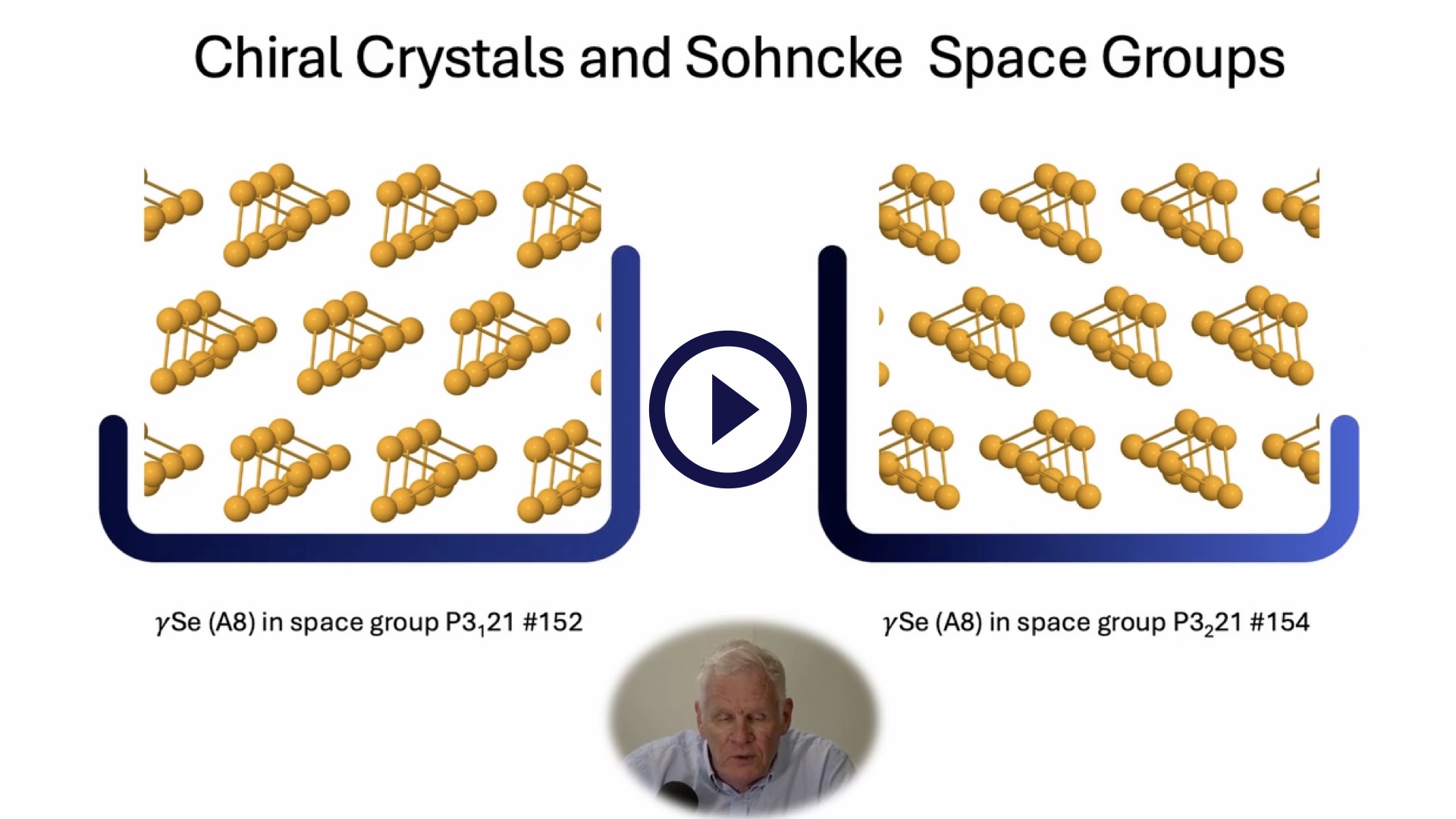
1 | Chiral Space Groups
Many crystals, particularly organics, are chiral pairs -- each has a mirror image structure with exactly the same properties as its twin. Why does this happen? How often does happen? What symmetries allow this? Who is the heck is Sohncke?
Here we explore the world of chiral systems and the space groups that allow them.
Date: 29th November 2024 | Presenter: Michael Mehl | Editor: Hagen Eckert
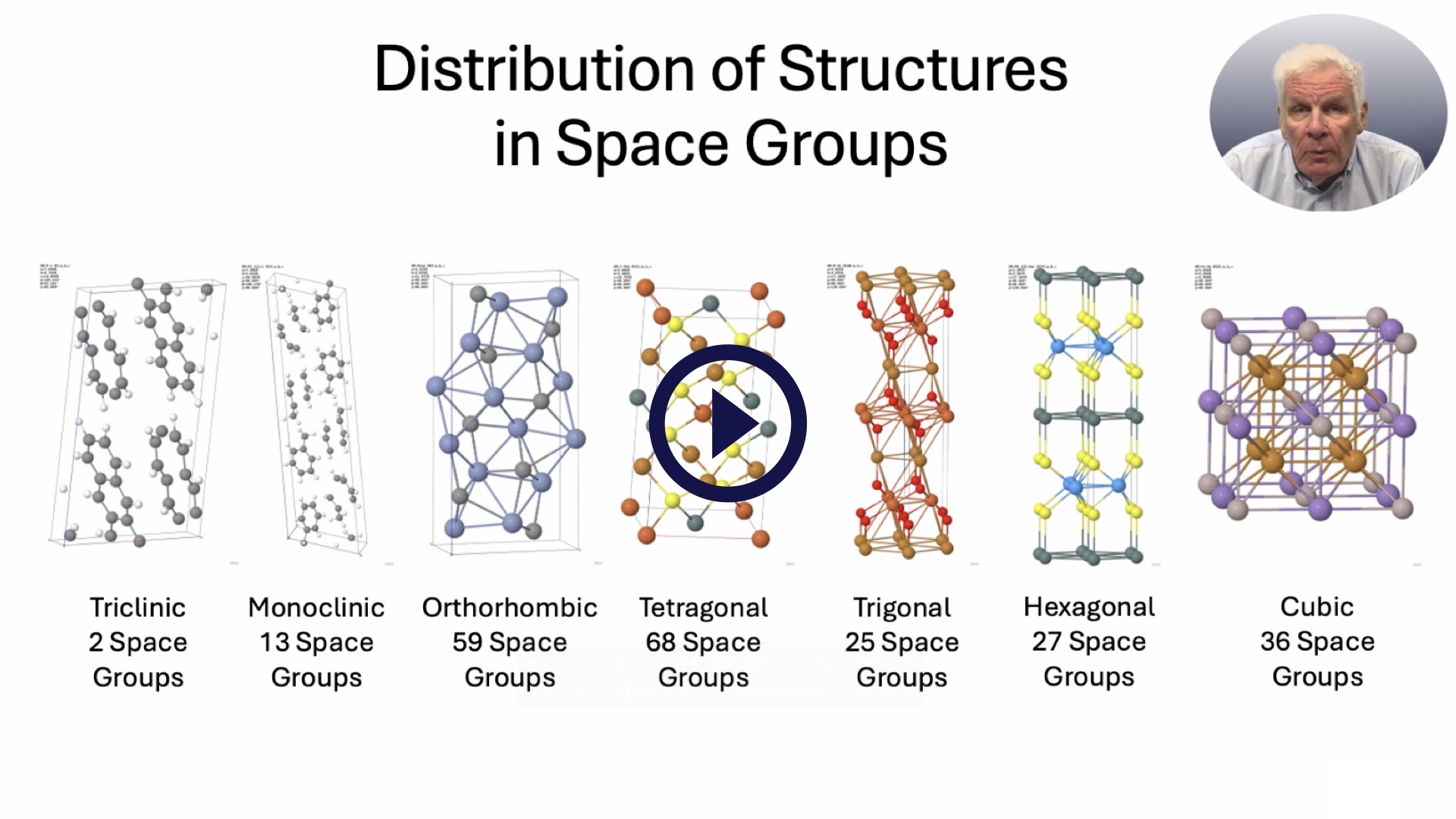
2 | Distribution of Structures in Space Groups
Crystals structures can be cubic, hexagonal, tetragonal, or have less regular shapes. But how many crystals of each type are there? If you pick up a random crystal, is it likely to have a cubic structure? Hexagonal? Does it depend on the sample being organic or not? We look at how many (and what kind) of crystals are in every symmetry and space group.
Date: 8th March 2025 | Presenter: Michael Mehl | Editor: Hagen Eckert
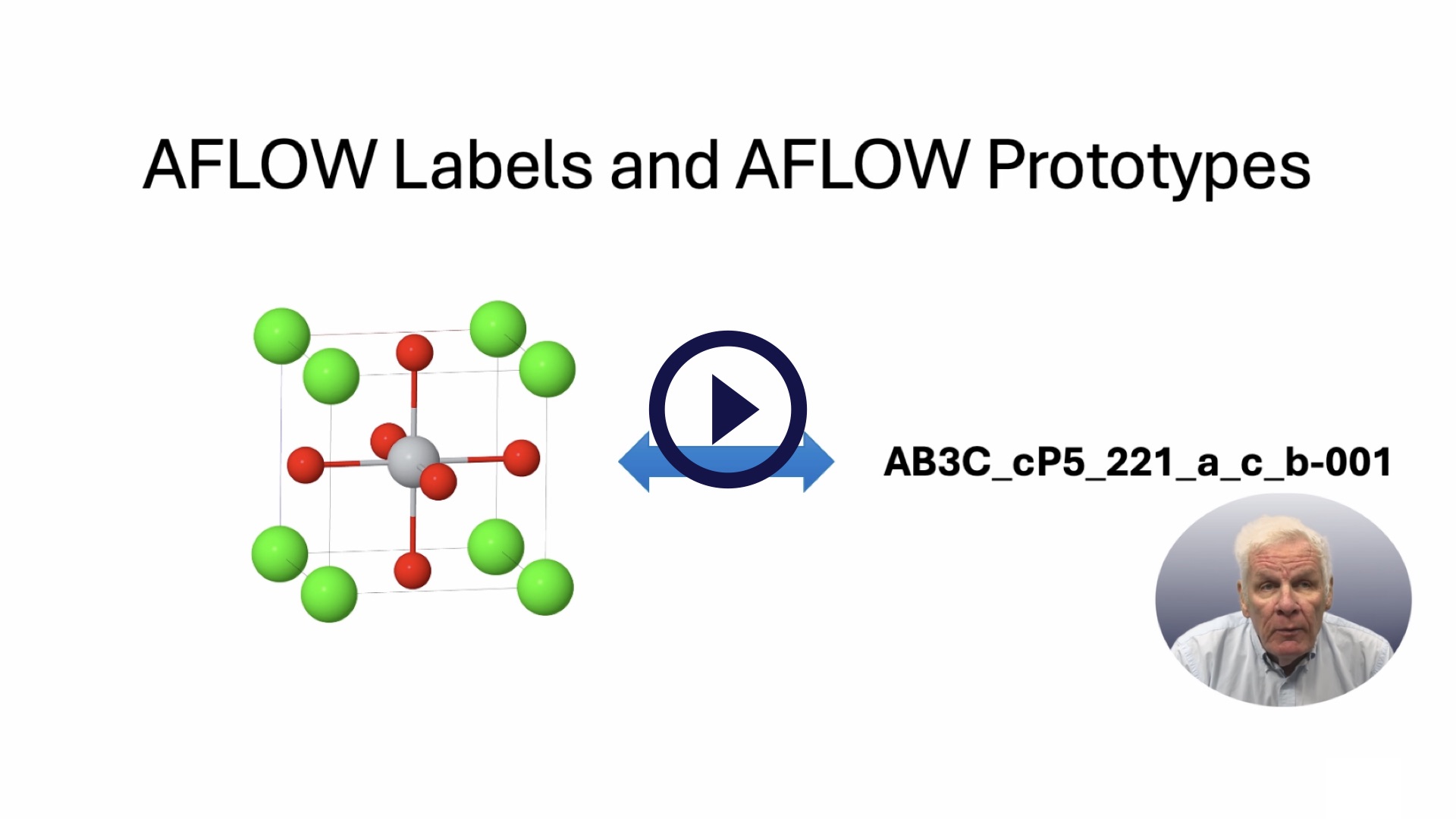
3 | The AFLOW Prototype Label
Every crystal structure in this Encyclopedia has what is known as an AFLOW Prototype Label which has information about its crystal structure and stoichiometry. So what does something like AB4C_tP12_127_a_eg_c-001 mean? We'll reveal the secrets of the Prototype Label, how you can construct one, and how (and when) to use it.
Date: 7th March 2025 | Presenter: Michael Mehl | Editor: Hagen Eckert
4 | Crystallography and Computational Quantum Mechanics
We covered many of the concepts of crystallography in our Two Dimensional Periodic Systems tutorials. However, there are some concepts such as screw axes and glide planes, that to do not exist in three dimensions. This set of tutorials covers (mostly) highlights crystallographic concepts in three dimensions. As with the two-dimensional articles, much of what is presented here can be found in a more formal version in D. Hicks et al., Comp. Mat. Sci. 161, S1-1011 (2019).
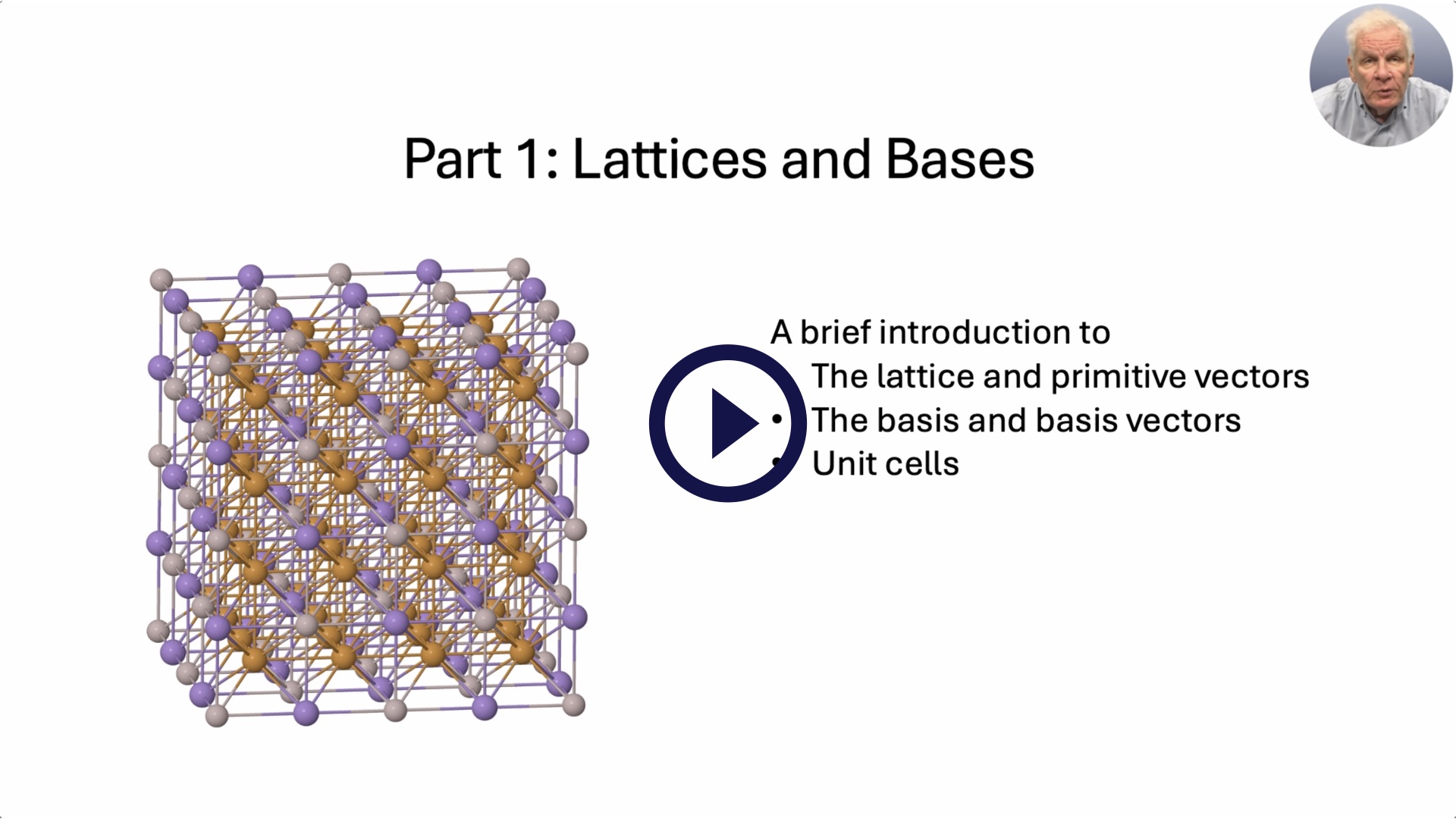
4a | Lattices and Basis
Every periodic crystal is defined by its lattice — how it repeats in space, and its basis — how the atoms are distributed in the lattice. This introduction to crystallography talks describes the possible types the lattice and basis, as well as the notation we use to describe them in the Encyclopedia and these tutorials.
Date: 30th October 2025 | Presenter: Michael Mehl | Editor: Hagen Eckert
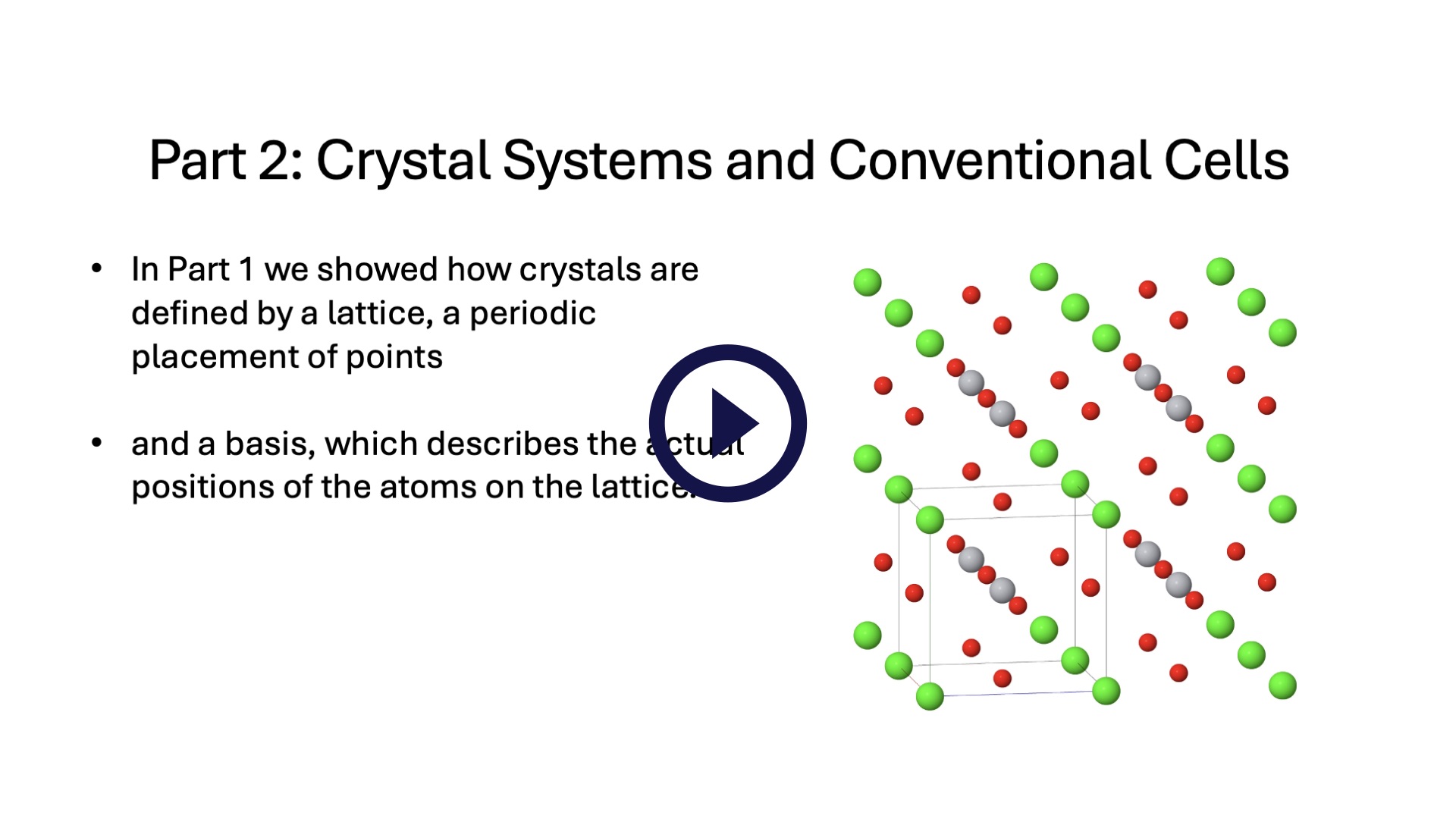
4b | Crystal Systems and Conventional Cells
Every lattice belongs to a crystal system: it has a well defined rotational and translational symmetry, defined by a specific type of "conventional" lattice and unit cell. Here we talk about the seven different crystal systems and how we define them.
Date: 19th March 2026 | Presenter: Michael Mehl | Editor: Hagen Eckert
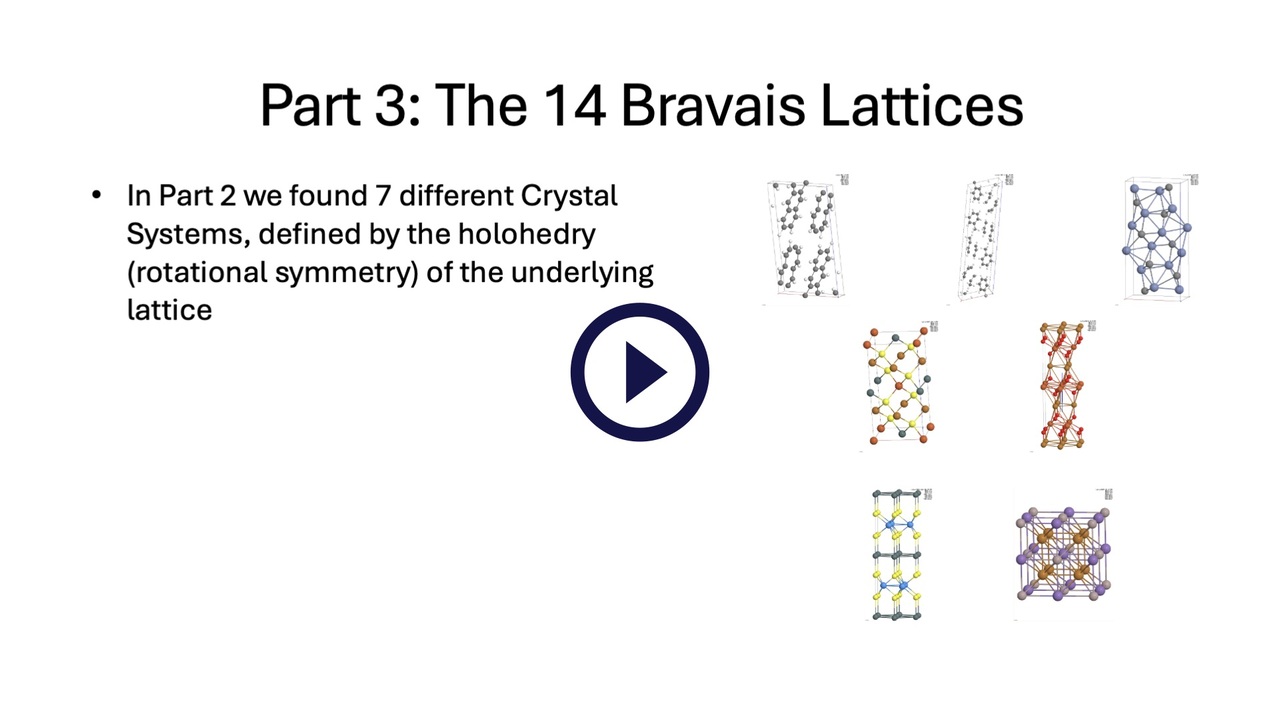
4c | Conventional and Primitive (Bravais) Lattices
Although there are only seven crystal systems, there are fourteen "Bravais" lattices. Most of these lattices belong to only one crystal system, but one — the hexagonal lattice, belongs to two. Let's see what the relationship is between a primitive Bravais lattice and its crystal system and conventional lattice.
Date: 2nd July 2026 | Presenter: Michael Mehl | Editor: Hagen Eckert
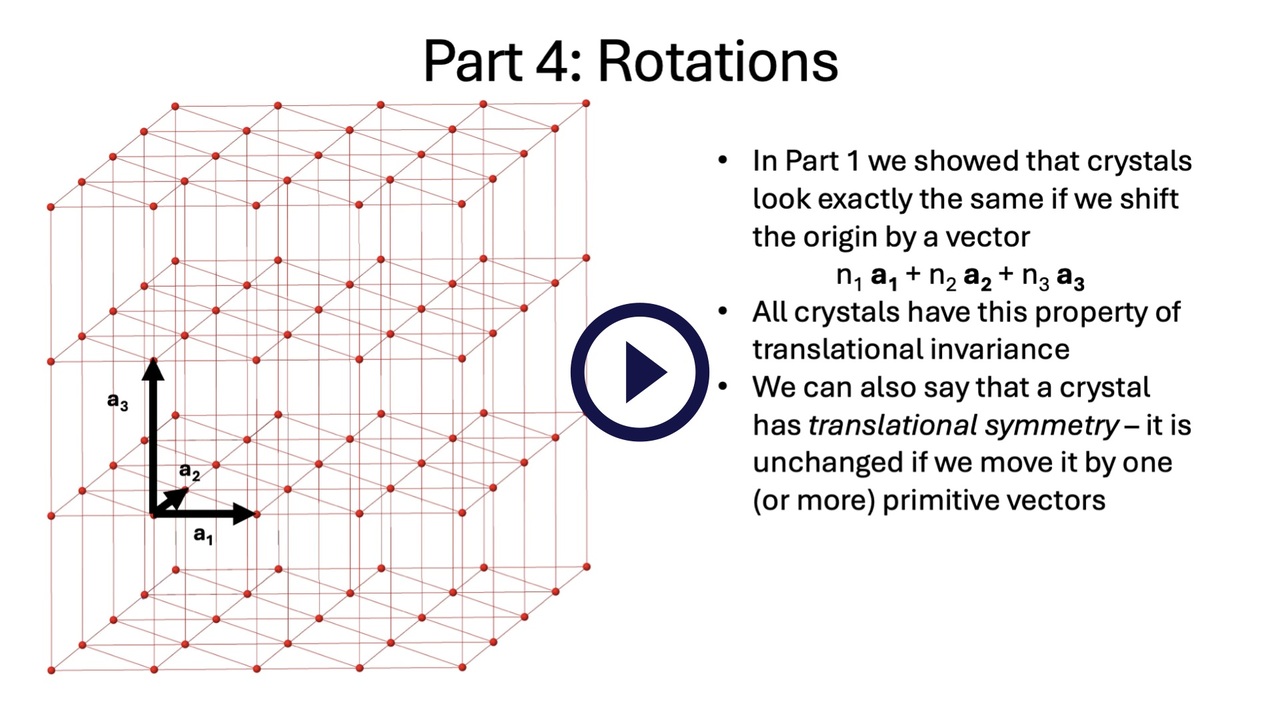
4d | Rotational Symmetry
All periodic crystals have translational symmetry – moving the unit cell over by a lattice vector results in an identical crystal. Many crystals also have rotational symmetry, where rotating the crystal by some angle, say 90o, results in an identical crystal. Every crystal system except triclinic can have these rotations, and we’ll look at all of them.
Date: 2026 | Presenter: Michael Mehl | Editor: Hagen Eckert
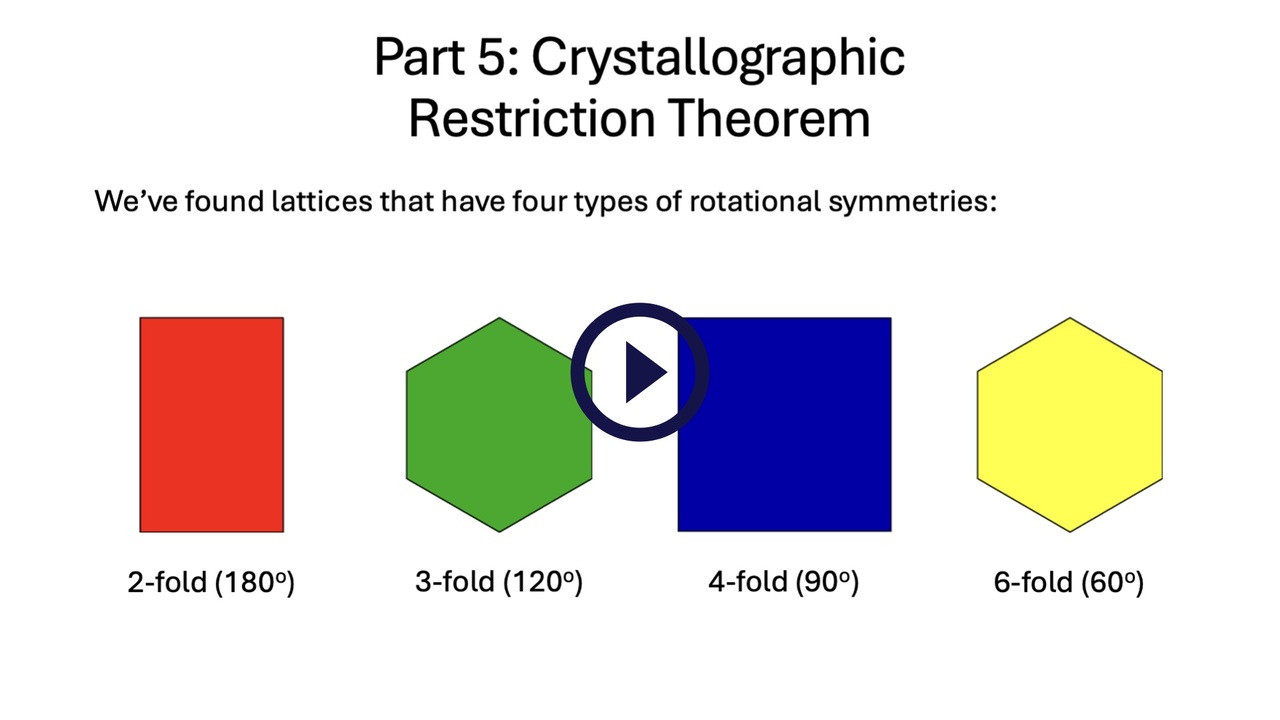
4e | The Crystallographic Restriction Theorem and Quasicrystals
Rotating a hexagonal crystal by 60º results in an identical hexagonal crystal. Rotating a tetragonal crystal by 90º results in an identical tetragonal crystal. So rotating a pentagonal crystal by 72º gives … oh, wait, there are no periodic pentagonal crystals. Why is that? We’ll see why 5-fold rotation axes are forbidden in three dimensions, and why that word “periodic” is important.
Date: 2026 | Presenter: Michael Mehl | Editor: Hagen Eckert
4f | Screw Axes
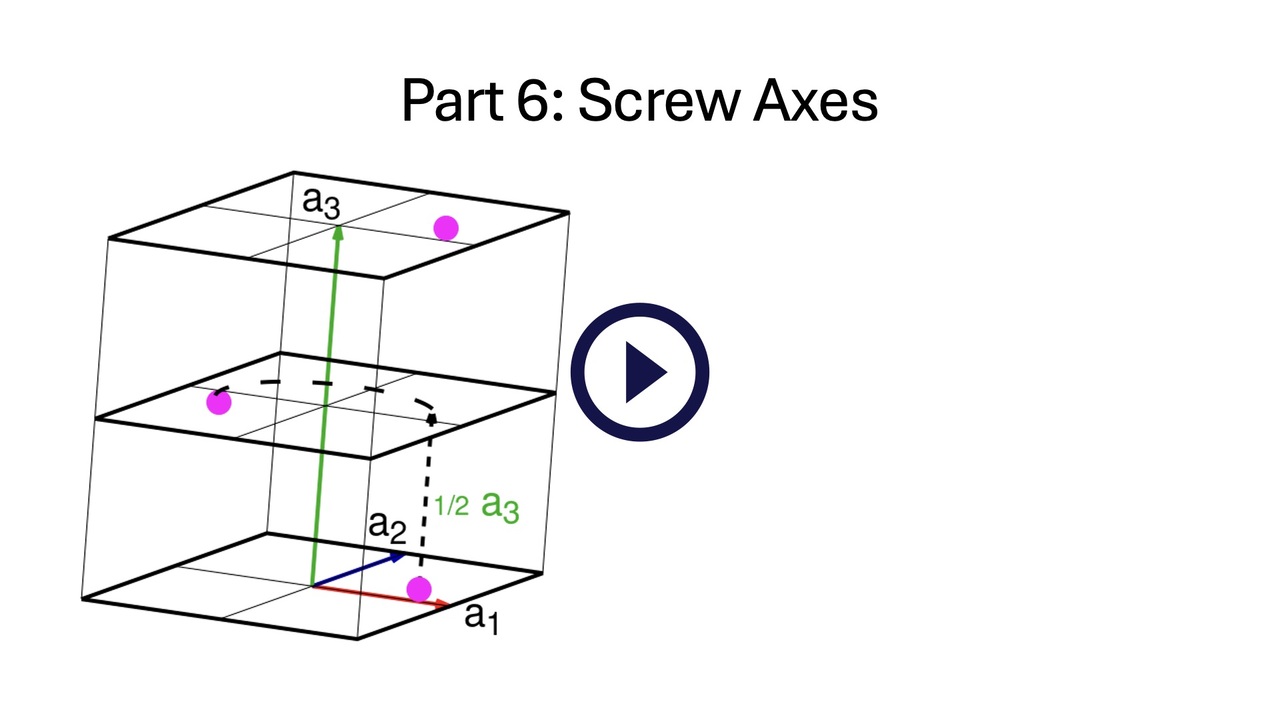
All periodic crystals have translational symmetry, and most have rotational symmetry. Suppose we combine the two, translating the atoms in a crystal in some direction while rotating around an axis pointing in that direction. Sometimes we get find an identical lattice, so those translations plus rotations are call screw axes. Here we’ll look at all the screw axes possible in three dimensions, and see which ones occur in each crystal system.
Date: 27th July 2026 | Presenter: Michael Mehl | Editor: Hagen Eckert
4g | 31 and 32 Screw Axes in Rhombohedral and Cubic Crystals
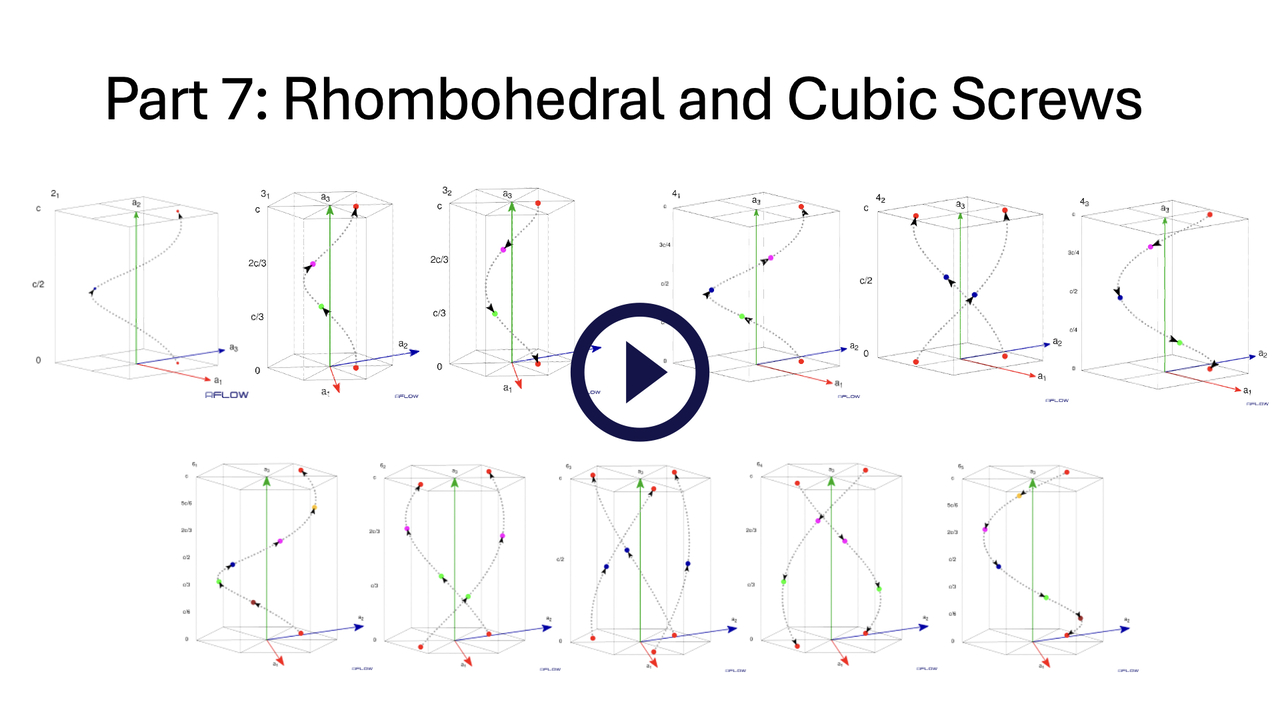
The screw axes we’ve previously studied required constructing an explicit set of operations to put the atoms in their proper places. Sometimes, however, screw axes form because of simple geometric factors. In the rhombohedral and cubic crystals simply stacking unit cells together causes 31 and 32 screws to form along axes parallel to the 3-fold rotation axis. We look at where, how, and why these screws form.
Date: 2026 | Presenter: Michael Mehl | Editor: Hagen Eckert
5 | Two Dimensional Periodic Systems
While most crystalline structures are three-dimensional,
periodic systems can exist in any dimensions. In
particular, two-dimensional crystals are interesting in
systems such as graphene, and concepts such as rotations,
inversions, and mirror planes are easily shown in a
two-dimensional medium such as this web page.
In the following we present a brief tutorial about
crystallography in two dimensions. A more formal version
can be found in D. Hicks et al., Comp. Mat. Sci. 161, S1-1011
(2019).
5a | Lattices and Translational Symmetry
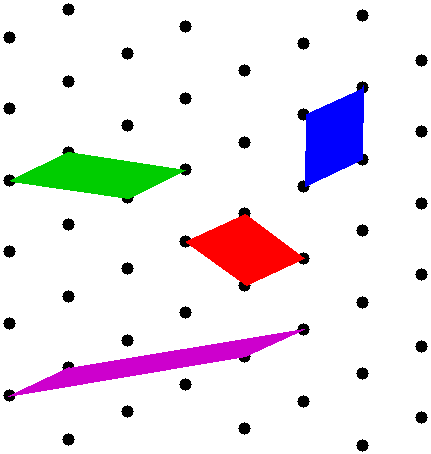
Periodicity is the heart of crystallography. In this write-up, we’ll discuss some of the basics of crystallography in two dimensions – unit cells, primitive vectors, and basis vectors.
Date: 5th January 2025 | Author: Michael Mehl
5b | Lattices and Symmetries
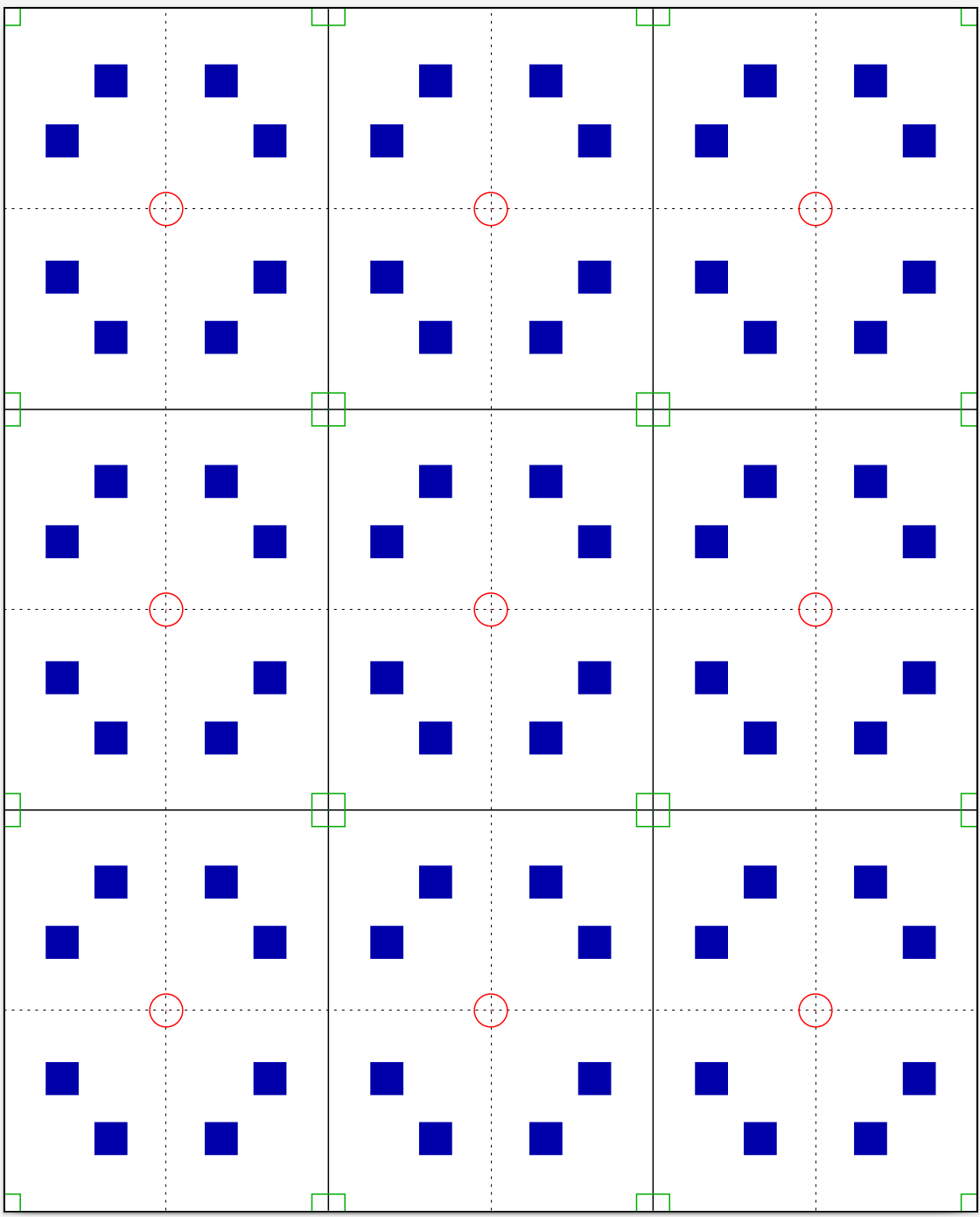
Any periodic crystal can have more symmetries than the periodicity that defines the lattice. In two dimensions these include rotations, mirrors, and glides. Here we examine all these operations and show how they specify specific atomic positions.
Date: 9th December 2025 | Author: Michael Mehl
5c | Possible Two Dimensonal Lattices
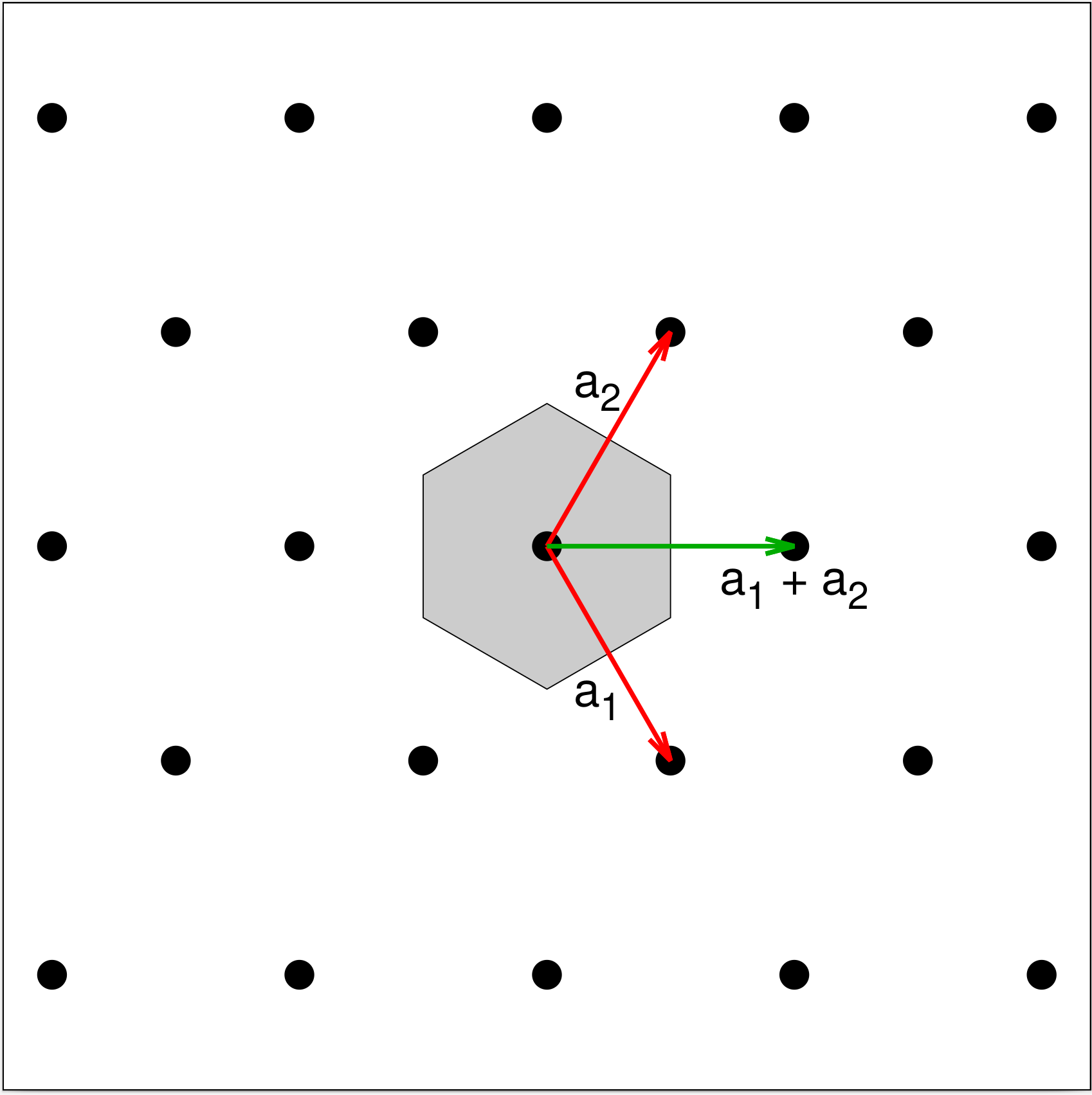
Translational periodicity limits the number of possible lattices that can occur in any n-dimensional system. Two dimensions allow five Bravais lattices. This section looks at all the lattices, and shows why we can never see a periodic system that looks like stacked pentagons.
Date: 23rd December 2025 | Author: Michael Mehl
5d | Two Dimensional Plane Groups
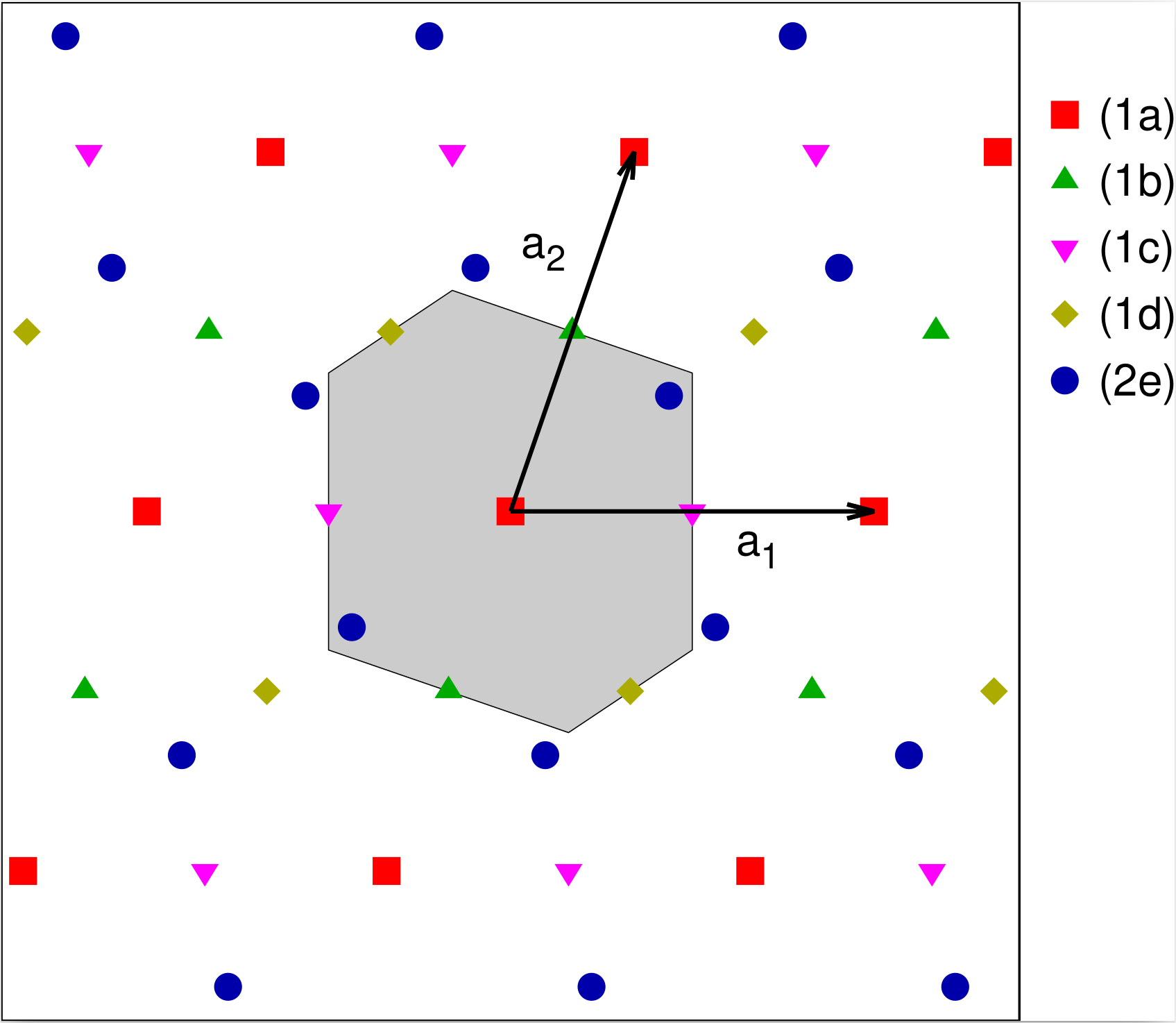
The possible atomic positions in a periodic crystal are controlled by the Bravais lattice and the rotations, mirrors, and glides we previously discussed. In two dimensions these operations can be combined to form fourteen distinct plane groups, spread over five crystal systems. We’ll look at the lattice, allowed operations, and atomic (Wyckoff) positions for each group.
Date: 13th January 2026 | Author: Michael Mehl
6 | Silica (SiO2) and Aluminum Phosphate (AlPO4)
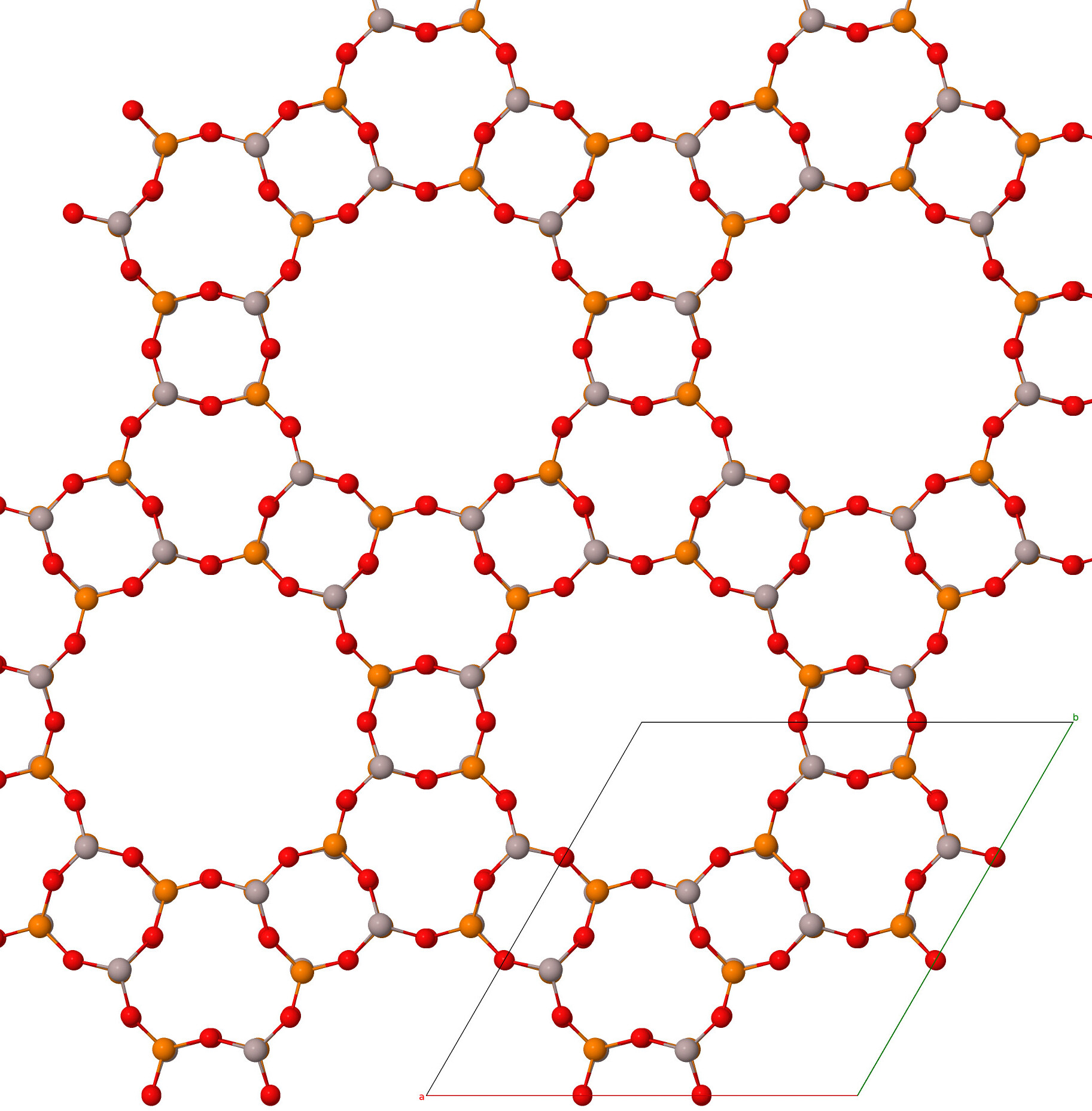
Crystalline silica, SiO2, forms in three-dimensional tetrahedrally based structures such as quartz. If we replace half the silicon atoms by aluminum and the other half by phosphorus we find many similar structures. However AlPO4 also forms in layered two-dimensional structures which are rather hexagonal and often contain large pores, making them ideal candidates for molecular sieves. Here we describe the large variety of SiO2 and AlPO4 structures included in the Encyclopedia, highlighting the relationships between these structures.
Date: 17th February 2025 | Author: Michael Mehl